Good morning. AI agents are about to field a lot of holiday questions about your store: can I return this, will it arrive by the 24th, do you gift-wrap? On Monday, Shopify put the facts they read into your admin, where you can check them. Meanwhile, Meta told investors that stores will pay a fee on the sales its agent makes, and ChatGPT starts rewriting ads on Friday.
In today’s brief:
- You can now edit what AI agents know about your store
- Meta wants a fee on the sales its agent sends you
- ChatGPT will rewrite your ads from Friday unless you opt out
- Try this: check what AI agents will say about your returns
The number: In the week of 12 October, 70% of AI agent orders on Forter's network came from agents that click through the store's own checkout pages, such as Meta's Muse. In late July it was 1%. The rest went through the checkout protocols OpenAI and Google built. Forter sells fraud tools for agent traffic and gives no order counts. Source: Forter.
Agents · lead story
You can now edit what AI agents know about your store
The brief: On 26 October, Shopify built Knowledge base into every store’s admin: one page where you review, edit and publish the facts AI agents get about your store. Shopify calls these facts “the source of truth for AI agents for all non-product information about your store”.
The details:
- It lives at Sales channels › Agentic › Knowledge base and replaces the Knowledge Base app, which closes on 15 January 2027.
- Shopify drafts the facts from your storefront pages, each linked to its source, in categories such as returns and warranty, delivery, payment, gift services and contact.
- Drafted facts wait for you to publish them. Facts from your admin, such as store policies and contact details, go live as soon as Shopify creates them.
- Published facts are open to AI channels “including Shop and third-party platforms”. Shopify doesn’t name which agents read them.
- A store can hold up to 1,000 facts. If the old app held more, your facts didn’t move over, and Shopify has emailed those stores.
Why it matters for your store: When an agent tells a shopper your return window this November, it may be quoting this page, not your returns policy. Return terms are turning into data too: on 23 October, the Universal Commerce Protocol that Google and Shopify use for agent checkout added a draft standard for return windows, fees and final-sale items. It isn’t in a release yet.
Your move · ACT: Open Knowledge base this week. Start with Returns & warranty and Fulfillment, the questions shoppers ask in November. Publish the drafted facts that are right, fix wrong ones on the page they came from, and add your holiday return window and last order dates as additional facts. After you fix a page, request a rescan: it can take up to 48 hours.
Evidence: Shopify changelog and Help Center, 26 October; Universal Commerce Protocol pull request on GitHub, 23 October.
Agents · business model
Meta wants a fee on the sales its agent sends you
The brief: On its earnings call on 21 October, Meta said shopping is the most common use of Muse, its personal AI agent, and that it will build tools “so we get paid a fee based on the transactions that we help facilitate.” Mark Zuckerberg added: “We expect this will be paid for by businesses.”
Why it matters for your store: Meta says more than 10 million people in the US and Canada set up Muse in six weeks, and over a quarter of Muse users shop with it, spending more than $200 a purchase on average (travel included). Meta named no fee, no start date and no list of businesses that would pay. If Muse already sends you orders, a per-sale fee changes what they’re worth. Separately, Meta’s new Commercial Terms, which let it crawl sites tied to what you sell on Meta, now start on 20 November, not 30 October.
Your move · WATCH: Note how many orders Meta's channel sends you each month in Shopify's sales-by-channel report, so you can judge a fee when Meta names one. And product browsing on existing ads starts tomorrow (reported), so decide today for your Black Friday ads: in Ads Manager, find Personalized destinations on the ad and click Edit.
Evidence: Meta's Q3 earnings call transcript, 21 October; Meta Commercial Terms preview and Business Help Center. Product browsing date reported by PPC Land.
Ads
ChatGPT will rewrite your ads from Friday unless you opt out
 Image source: OpenAI, original announcement.
The brief: From Friday 30 October, OpenAI switches on “creative enhancements” for new and existing ChatGPT ad campaigns. ChatGPT can then rewrite your headlines and descriptions, resize images, change the destination URL and translate the ad, and run those versions without asking you first.
Why it matters for your store: OpenAI says there’s no preview of every version, which is a risk for a Black Friday offer with conditions or a landing page you picked on purpose. And the channel is growing: since 21 October, ChatGPT ads run in 89 countries, OpenAI says more than 100,000 advertisers have used them, and a multi-image format (four to six square images, one link) opened in beta on 26 October.
Your move · ACT: If you run ChatGPT ads, open Ads Manager › Manage settings by Thursday and turn creative enhancements off for the account. Opt-outs you already set stay in place. Then switch it on for one evergreen campaign and compare its sales in Shopify with the rest.
Evidence: OpenAI Help Center and announcement, 21 and 26 October.
Shelf watch
Where AI shopping stands this week
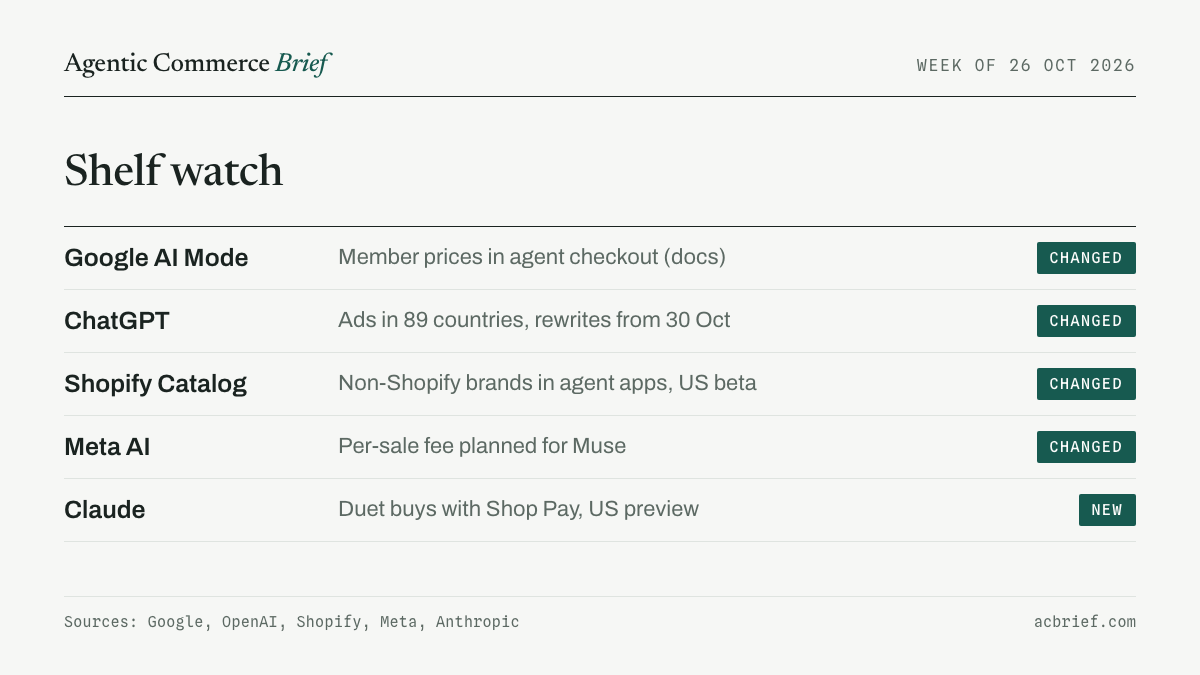
- Google AI Mode · CHANGED: Google’s agent checkout can now show member prices and perks to shoppers who link their store account (developer docs, 22 October). The Universal Cart icon now shows by default in US Search (reported).
- ChatGPT · CHANGED: ads in 89 countries, with creative enhancements on from 30 October.
- Shopify Catalog · CHANGED: apps built on it can now show brands that don’t sell on Shopify next to yours (beta, US shoppers). If your Shop Campaigns run on “other platforms”, those apps can now earn the commission you fund; Shopify’s merchant help page doesn’t say so yet.
- Meta AI · CHANGED: a per-sale fee is planned for Muse, with no amount or date.
- Claude · NEW: Anthropic’s Claude Duet (research preview, US) can buy from stores with Shop Pay, using a one-time card for each purchase. The store handles refunds and returns.
- Copilot · STEADY: no shopping news this week.
Try this · 10 minutes
Check what AI agents will say about your returns
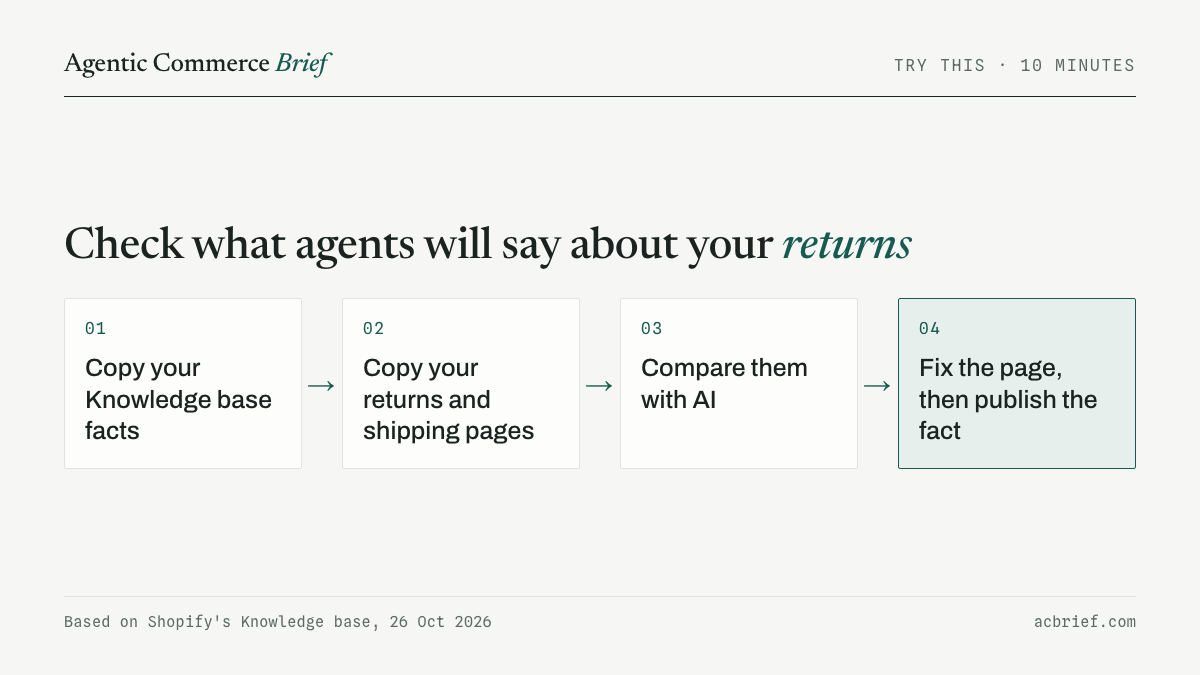
Agents will answer holiday questions from your Knowledge base. Make sure it agrees with your own pages.
- In Shopify, open Sales channels › Agentic › Knowledge base and copy the facts under Returns & warranty and Fulfillment.
- Copy the text of your returns policy and shipping pages.
- Paste both into ChatGPT, Claude or Gemini with the prompt below.
- Fix each contradiction on your store page first, then edit or publish the fact. Add missing answers as additional facts.
Prompt: Below are (1) the facts my store publishes to AI shopping agents and (2) my returns and shipping pages. List every place where they disagree, quoting both. Then list the questions a holiday shopper might ask an AI about my store that neither answers, such as the holiday return window, final-sale items, who pays return shipping, gift receipts, and the last order date for delivery by [24 December] in [country]. Draft each missing answer in one sentence, using only what my pages say. Mark anything my pages don't cover as "ask me". Don't guess. (1) [paste facts] (2) [paste pages]
Tool radar
Three tools, three verdicts
- USE · Shopify Rollouts for catalogs, built in: since 23 October, Rollouts can switch Black Friday prices and availability per market at a set time and roll them back after. Shopify doesn’t say whether AI channels update at the same moment, so check your top products once it runs. Plan availability is on Shopify’s requirements page.
- TEST · OtterlyAI Brand Profiling, from $29 a month: a new tab (21 October) showing the attributes, objections and sources AI answers attach to your brand. The base plan covers ChatGPT, Google AI Overviews, Perplexity and Copilot for 15 prompts. Use it to find wrong claims to fix in your Knowledge base.
- SKIP · Evertune Starter, for most stores this season: for $60 a month (20 October), it finds topics where AI recommends rivals, then writes ChatGPT ad campaigns on them for 10% of media spend. With ChatGPT’s own rewrites starting Friday, I wouldn’t add a second layer of automated copy before Black Friday.
Quick hits
Everything else
- Google Ads is rolling out Loyalty Mode (member prices or messages for people in your loyalty program), Retention Only Mode, High Value Mode for Shopping campaigns and percentage bid multipliers this month. Google doesn’t say how it spots loyalty members. Google’s announcement.
- Performance Max campaigns created after 4 December will pull images from your landing pages by default, even if you switched that off for the account. Existing campaigns keep their settings. Google Ads Developer Blog.
- Google Search ads can now carry AI-written summaries of your reviews from across the web: positive only, and you can’t edit them (US, UK, Australia and India, in English). Google Ads Help.
- Walmart will give shoppers’ AI agents their own profiles with spending limits from next month, and will block agents that ignore its new terms. Agents see the same prices people do. Walmart’s announcement.
Before you go
Have you opened Shopify’s Knowledge base yet? Reply with the one fact it got wrong about your store. The most useful answers go into next week’s brief, anonymously.
New here? Score your store with our free AI Shelf Checklist. Know someone who runs an online store? Forward them this email. They can subscribe free at acbrief.com.