Good morning. AI agents still send most stores a trickle of orders, but on Shopify that trickle more than tripled in a year. To get any of it, your products have to be in the data the agents read, and Shopify now tells you whether they are. Also this week: Google put ads inside AI Mode answers in 10 more countries, and Meta’s pixel starts counting more of your sales two weeks before Black Friday.
In today’s brief:
- Shopify now shows if AI agents can sell your products
- Google ads now run inside AI Mode in 10 more countries
- Meta will count more of your sales from 12 November
- Try this: find the products AI agents might skip
The number: In September, visits to US retail sites from AI sources converted 90% better than other visits, Adobe says. In August 2025 they converted 9% worse. Adobe measured more than 1 trillion visits but doesn't say what share of traffic comes from AI, and it sells analytics tools. Source: Adobe.
Agents · lead story
Shopify now shows if AI agents can sell your products
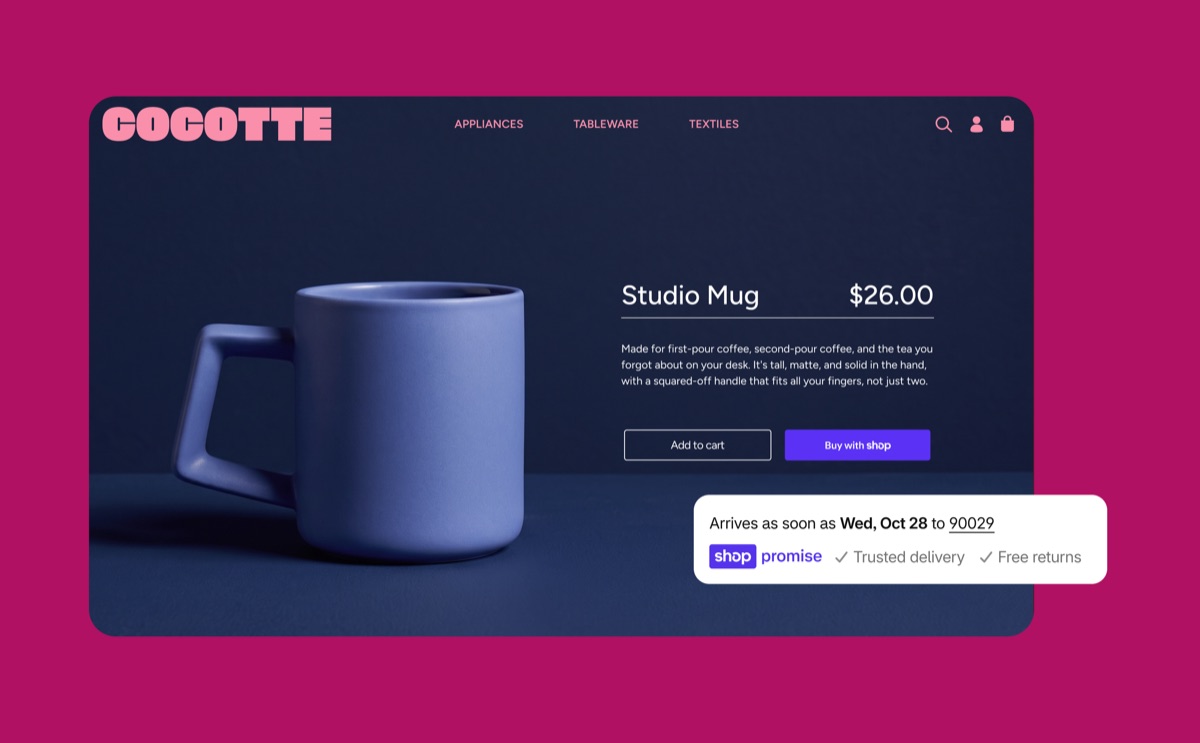 Image source: Shopify, original announcement.
The brief: In its Fall ‘26 Edition on 28 October, Shopify added a view to the admin that shows whether your store is eligible for Shopify Catalog, with links to fixes. Shopify says ChatGPT, Copilot, Meta, Instinct and other AI agents get their product information from Catalog.
The details:
- Look under Sales channels › Agentic, next to Sources › Shopify Catalog. Shopify’s help page says a reason “might” show there if your store isn’t eligible, such as a store password, B2B-only selling, or your account standing.
- The store rules: Starter plan or higher, no password, and a “track record of genuine sales”, orders fulfilled promptly, a low chargeback rate and invoices paid on time. Shopify gives no thresholds.
- The product rules: a title, an image, a price above zero and a product URL. Alcohol, CBD, weapons, services and add-ons, event tickets and products Shopify classifies as “Uncategorized” are left out. Shopify classifies products from your product information, which can differ from the category you set.
- Checkout in Google AI Mode and Gemini through Shopify also needs Catalog eligibility. Since late October it covers shoppers in Canada and Australia as well as the US, from stores based anywhere (rolling out, on by default, no fee).
- In the US, products with a Shop Promise badge (trusted delivery, returns) “can also rank higher” in the Catalog data shopping agents use. The program is free.
Why it matters for your store: On its earnings call on Tuesday, Shopify said orders from AI channels are up 3.3x year on year and traffic 2.6x, while “the volume is still small”. It said searches powered by Catalog convert at twice the rate of general AI search, and that 74% of AI-attributed purchases came from outside its top 100 categories. Agents reward specific products. A store that isn’t in Catalog misses all of it, and vague product information can get single products classified out.
Your move · ACT: Today, open Sales channels › Agentic and read the line next to Shopify Catalog. If there's a message, follow its link. Then check your 20 best sellers for vague titles and descriptions (the Try this below takes 10 minutes). US stores: open Settings › Shipping and delivery and check the Shop Promise card. If you turn on return rules there, update your written return policy to match.
Evidence: Shopify Fall '26 Edition and Help Center, 28 October to 3 November; Shopify's Q3 earnings call, 3 November (third-party transcript).
Ads · AI Mode
Google ads now run inside AI Mode in 10 more countries
 Image source: Google, original announcement.
The brief: On 28 October, Google said it is scaling ads in AI Mode to Australia, Canada, India, Kenya, Malaysia, New Zealand, Nigeria, Pakistan, the Philippines and Singapore, and adding ads to follow-up questions in the US. Brazil, Mexico and the UK are planned for later this quarter.
Why it matters for your store: Google told investors the same day that AI Mode’s “lower monetization” had weighed on Search, and that it is now scaling ads “to more users and more queries”. Your existing Search, Shopping and Performance Max campaigns in those countries are automatically eligible. Google’s help page says you can’t target AI Mode on its own or opt out of it, results are folded into your normal reporting, and the language is English only. Google says sponsored and organic product listings in AI Mode already get similar click-through rates, based on its own US data.
Your move · WATCH: If you advertise in one of the new countries, write down this week's cost per sale for your Shopping and Performance Max campaigns there, and compare it each week through Black Friday. Negative keywords and brand exclusions are your only controls, so check them now.
Evidence: Google announcement and Alphabet's Q3 earnings call, 28 October; Google Ads Help.
Measurement
Meta will count more of your sales from 12 November
The brief: A new Meta pixel setting, “Measure conversions on customer devices”, matches ad views to purchases on the shopper’s own device. Meta’s help pages say it’s on by default for eligible pixels and not active for people in the EU and UK. The settings screen gives 12 November as the start date (reported).
Why it matters for your store: Meta says the setting lets you “see more of the conversions that you drive” and gives campaigns “a stronger signal”, while your attribution window and model don’t change. So Meta-reported purchases and ROAS can rise two weeks before Black Friday without a single extra sale. Meta’s requirements include a pixel on the page itself and a site where people log in with an email address or phone number. It doesn’t say how stores with guest checkout fit.
Your move · ACT: Before 12 November, note last week's Meta-reported purchases and ROAS for your main campaigns next to your total orders in Shopify. After the 12th, judge budget changes on Shopify orders, not on the jump. You'll find the setting in Events Manager › Data sources › your pixel › Settings.
Evidence: Meta Business Help Center; 12 November start date reported by PPC Land from the settings screen.
Shelf watch
Where AI shopping stands this week
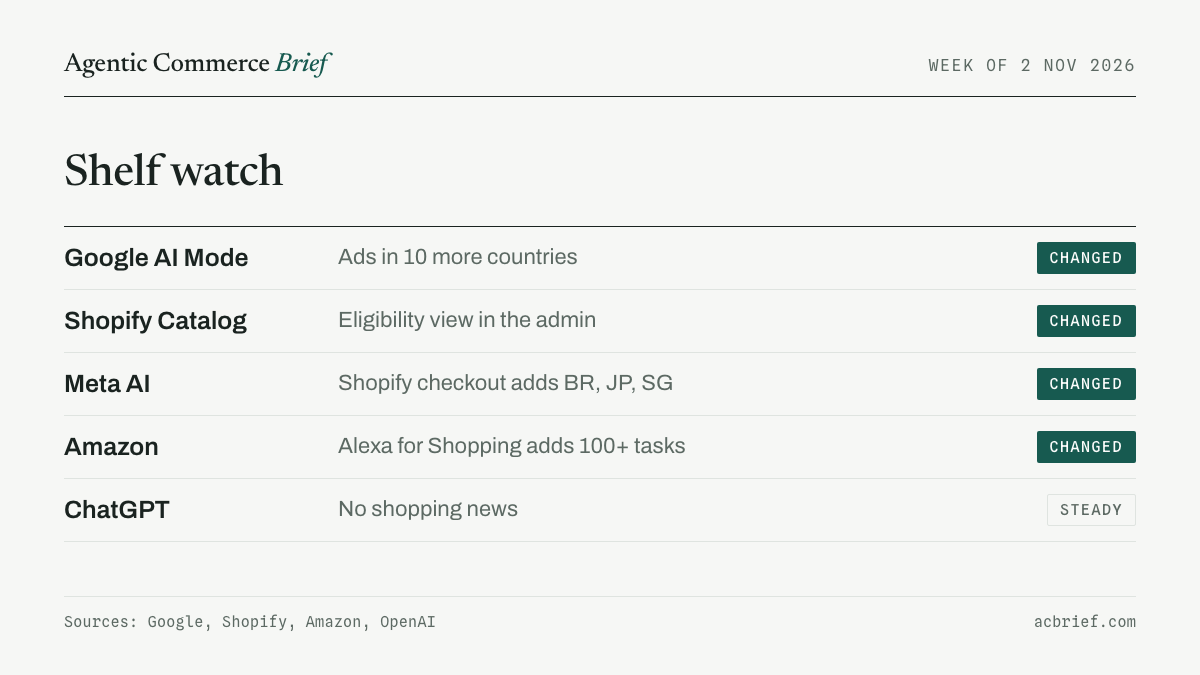
- Google AI Mode · CHANGED: ads in 10 more countries and on follow-up questions in the US. Shopify’s checkout in AI Mode and Gemini now covers Canada and Australia. Google told investors that UCP, its agent checkout standard, “enables direct checkout for hundreds of thousands of brands”.
- Shopify Catalog · CHANGED: an eligibility view in the admin, and Shop Promise badges as a ranking signal (US).
- Meta AI · CHANGED: checkout on Meta for Shopify stores now also reaches shoppers in Brazil, Japan and Singapore, according to Shopify’s help page. Meta hasn’t confirmed that product browsing switched on for existing ads on 28 October, so check Personalized destinations on your Black Friday ads.
- Amazon · CHANGED: Alexa for Shopping added more than 100 tasks for US customers, such as gift lists and Subscribe & Save changes. Amazon says over 400 million customers used it in the last 12 months. On the earnings call, Andy Jassy said shopping through outside agents is “still not great” (transcript).
- ChatGPT · STEADY: no shopping or checkout news. Creative enhancements for ads have been on by default since 30 October.
- Copilot · STEADY: no shopping news. Microsoft’s Clarity saw a checkout in 25% of website sessions involving AI agents, against 15% of sessions by people (all industries, 13 August to 9 September).
Try this · 10 minutes
Find the products AI agents might skip
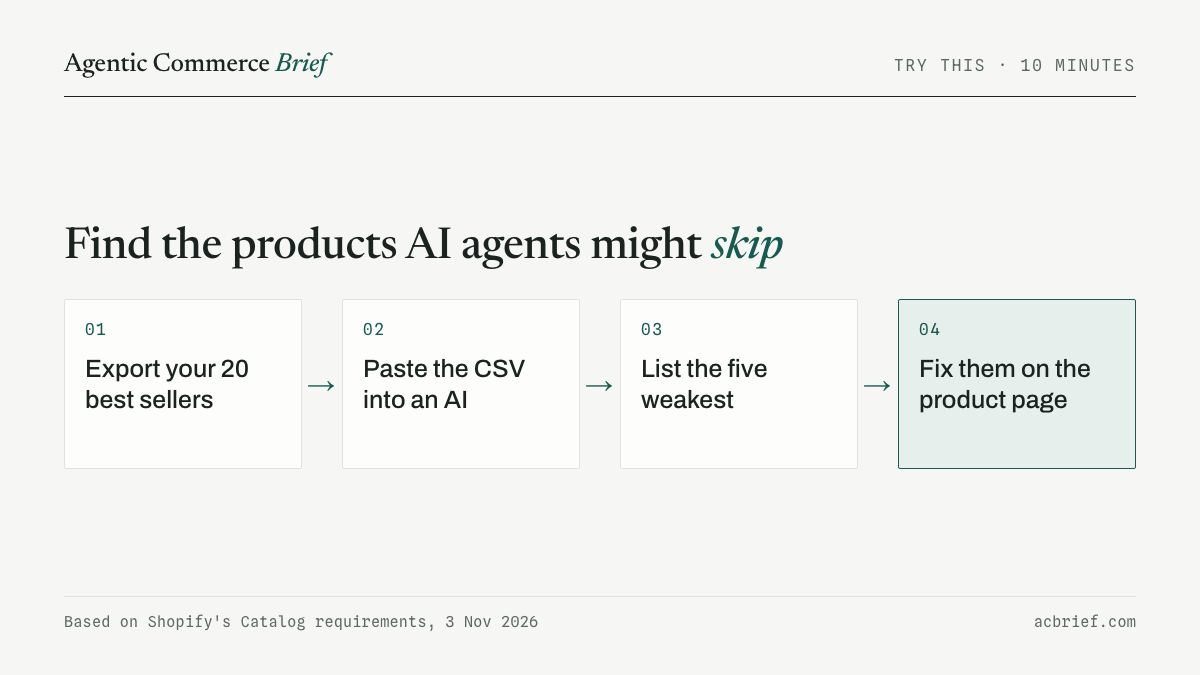
Agents reward specific products, and Shopify sorts yours into categories from what your product information says. Check your best sellers.
- In Shopify, go to Products, select your 20 best sellers, click Export and choose the selected products.
- Paste the CSV into ChatGPT, Claude or Gemini with the prompt below.
- Read the five weakest products it lists, and check each one against the real product.
- Fix them on the product page. For a change you want on one channel only, such as your brand in the title, use the new channel mapping page.
Prompt: Below is a CSV export of my 20 best-selling products. AI shopping agents match products to very specific requests. For each product, flag anything that could make it hard to match or classify: a vague title, a description that doesn't say what it is, who it's for, its material, size or colour, an empty Product Category, a missing barcode (GTIN), no image, a price of 0, or words an AI could read as mature content. List the five weakest products first. For each, rewrite the title as [brand] + [product type] + [key attribute] + [size or colour] and write a two-sentence description, using only facts in the CSV. Mark anything you'd need to ask me as "ask me". Don't invent specs. [paste CSV]
Tool radar
Three tools, three verdicts
- USE · Shopify channel mapping, built in: since 28 October, one page sets the title, brand, colour and barcode each sales channel gets, including Shopify Catalog, and shows how complete each field is as a percentage. Your store pages don’t change. Price can’t be mapped, and Shop and Shopify Collective aren’t covered.
- TEST · Shopify Protect Rule Builder, free to install, then $0.07 per screened transaction: write your own fraud rules (block, ask for 3D Secure, or hold for review) and preview each one on your last 90 days of orders. Basic fraud protection is already free on Shopify Payments. I’d backtest now and not switch on new blocking rules in Black Friday week.
- SKIP · Sidekick’s AI-tested storefront suggestions, before Black Friday: since 28 October, Sidekick suggests theme changes tested on simulated shoppers. Shopify says they “are not tested on real shoppers and are not live A/B tests”, and they cover desktop add-to-cart only. Shopify’s SimGym app, which runs similar simulations, is a research preview that charges per run. Don’t change your theme on simulated wins in peak season.
Quick hits
Everything else
- Shopify opened Campaign Autopilot to every merchant: one place to run Meta, Microsoft, Snapchat, Shop Campaigns and Shopify Messaging, with X coming. It’s free apart from ad spend, but your monthly budget is a “spend target” it can go over. Shopify’s changelog.
- Visa says nearly 50 AI partners are live on its network, Shop Pay among them, but agent payments are still “a very small amount”. Mastercard says agent transactions are “not yet significant” and that Shop Pay uses its Agent Pay tokens. Visa’s earnings call transcript.
- TikTok web-traffic ads can now show up to 35 discounts (percent off, cash off, free shipping) on the ad’s button, pulled automatically from Shopify. TikTok gives no countries or dates. TikTok’s product preview.
- Google, Microsoft and OpenAI back one robots.txt line to opt out of AI training. Google aims to honour it in 2027 and Bing from 1 February 2027. It doesn’t cover AI answers: Bing has a separate setting for those, and blocking it means “reduced brand visibility in AI experiences”. Bing’s announcement.
Before you go
Did Shopify show a Catalog message for your store, or did the prompt flag a best seller you didn’t expect? Reply with what you found. The most useful answers go into next week’s brief, anonymously.
New here? Score your store with our free AI Shelf Checklist. Know someone who runs an online store? Forward them this email. They can subscribe free at acbrief.com.