Most e-commerce teams still treat the product feed like backend plumbing.
Titles, prices, variants, categories, inventory, images. Keep it clean enough for Google Shopping, Meta catalogs, marketplaces, and the store theme. Then move on.
That model is starting to break.
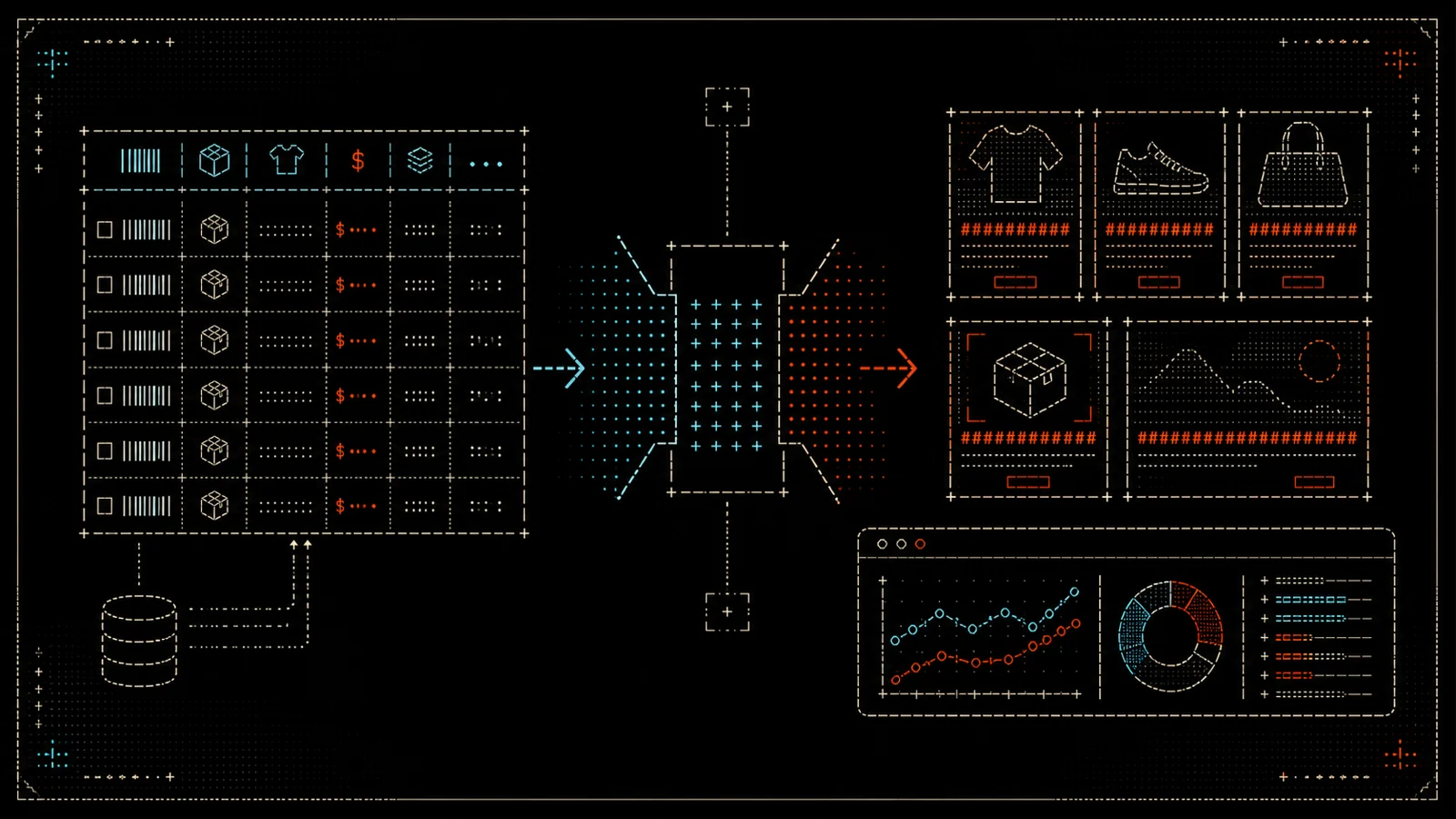
The product feed is becoming an upstream creative system. It can shape SKU-level ads, landing page sections, email blocks, AI-generated product visuals, support answers, recommendation logic, and reporting summaries.
In other words: your product feed is becoming the creative brief.
The signal
Agentic commerce is not just chatbots on storefronts. It is a shift in how commerce work gets done.
Agents and automation need inputs they can understand: who the product is for, why people buy it, what objections appear in reviews, which claims are approved, what visuals are missing, what channels matter, and what a human needs to approve before anything goes live.
If those inputs are trapped in scattered spreadsheets, product descriptions, ad account comments, support tickets, Slack threads, and founder memory, the output will be weak.
That is why the first serious AI commerce project is often not another tool.
It is the input layer.
Why this matters now
Creative production is getting more granular.
Brands do not just need one hero ad or one landing page. They need product-level variants, offer variants, PDP improvements, lifecycle email blocks, social proof snippets, and fast feedback from performance data.
AI can help with that volume, but only if the product context is structured.
A model can rewrite a product description. It can summarize review objections. It can draft ad angles. It can turn a feed row into a landing page section. But it still needs useful information.
Bad feed in, bland creative out.
What the old workflow missed
The old workflow separated product data from creative strategy.
Operations kept the feed accurate. Creative teams made the ads. Merchandising owned the product page. Support knew the objections. Performance marketers saw what converted. Analytics reported what happened after the fact.
That separation worked when the system moved slowly.
It works less well when you want agents to help inspect PDPs, draft creative briefs, generate image prompts, summarize customer objections, recommend landing page tests, or produce SKU-level campaign ideas.
The agent needs the connective tissue.
Catalog creative is the early clue
Tools like Marpipe are interesting because they point at a specific workflow: product feeds becoming branded, testable catalog creative.
The lesson is not that every brand should copy one tool. The lesson is that feed data, templates, brand rules, and automation can become a performance system.
Creative teams do not disappear in that system. Their job becomes more strategic. They define the templates, claims, proof points, visual rules, and approval standards that automation can safely reuse.
The team audit
Pick your top 20 SKUs and answer these questions:
- Is the product title clear enough for both a human and an agent?
- Are the main benefits written somewhere structured?
- Do you know the top objections from reviews, returns, or support?
- Is there a proof point the brand is comfortable using?
- Are the product images consistent enough for ad creative?
- Can this product support three to five distinct ad angles?
- Could an agent understand who buys this product and why?
If the answer is no, do not start with a complicated AI stack.
Start by cleaning the context.
Tool radar: Marpipe
Marpipe is worth watching because it shows how product feeds can move from raw catalog data into branded creative systems.
Best for: brands already running catalog ads or Dynamic Product Ads at meaningful scale.
Watch if: you care about product-feed creative, SKU-level testing, and brand-safe automation.
Not for: teams that have not yet cleaned product data or do not have enough catalog/ad volume to learn from variants.
Team action
Create a working sheet for your top 20 SKUs with these columns:
- product
- primary customer
- main benefit
- top objection
- proof point
- image gap
- three ad angles
- best channel
- human approval notes
That sheet is not busywork. It becomes the source material for better ads, PDP updates, email sections, reporting summaries, and AI-assisted workflows.
The first step toward agentic commerce is not magic.
It is making your store understandable enough for agents to help.
Source links
- Marpipe: https://www.marpipe.com/
- Shopify Editions: https://www.shopify.com/editions