Support tickets are a product-page dataset.
Most teams do not treat them that way.
They answer the question, close the ticket, maybe tag the issue, and move on. The same question comes back next week from another shopper.
That is fine when support is only reactive.
It is a problem when support agents, shopping assistants, and automated workflows become part of the buying journey. If the product page never learns from support, the same confusion keeps getting automated downstream.
The better pattern is simple: every repeated support question is a candidate PDP fix.
In this brief
- Support conversations can reveal where product pages are weak.
- AI support agents need better product context, not just better macros.
- Tool Radar: Gorgias as a support and shopping-agent layer for Shopify brands.
- Team action: turn the top 10 support questions into product-page updates.
The signal
Support platforms are moving closer to commerce workflows.
Gorgias describes its AI Agent as trained on brand policies, website content, and Shopify data, with support and shopping-assistant skillsets across pre-purchase and post-purchase conversations. Siena positions itself around AI agents built for commerce customer service. Okendo Surveys frames customer insight as something brands can collect during different stages of the online buying journey. Shopify Flow gives merchants trigger, condition, and action-based workflow automation inside the store operation.
Taken together, that points to a useful idea:
Support is not just where customer confusion ends.
It is where product-page improvement should begin.
Why this matters for commerce
Pre-purchase questions are often a sign that the product page failed to answer something important.
Common examples:
- “Will this fit?”
- “Is this compatible with my setup?”
- “What is included?”
- “How long does it take to ship?”
- “Can I use it for this situation?”
- “What is the difference between these two products?”
- “Is this safe for kids, pets, sensitive skin, travel, outdoor use, or a specific material?”
If humans keep answering those questions in support, an AI agent will eventually answer them too.
That makes source quality matter.
An agent trained on vague product pages and scattered policies can only do so much. Better PDP content, clearer FAQs, structured policies, and tagged support themes give the agent a cleaner operating base.
Workflow lens
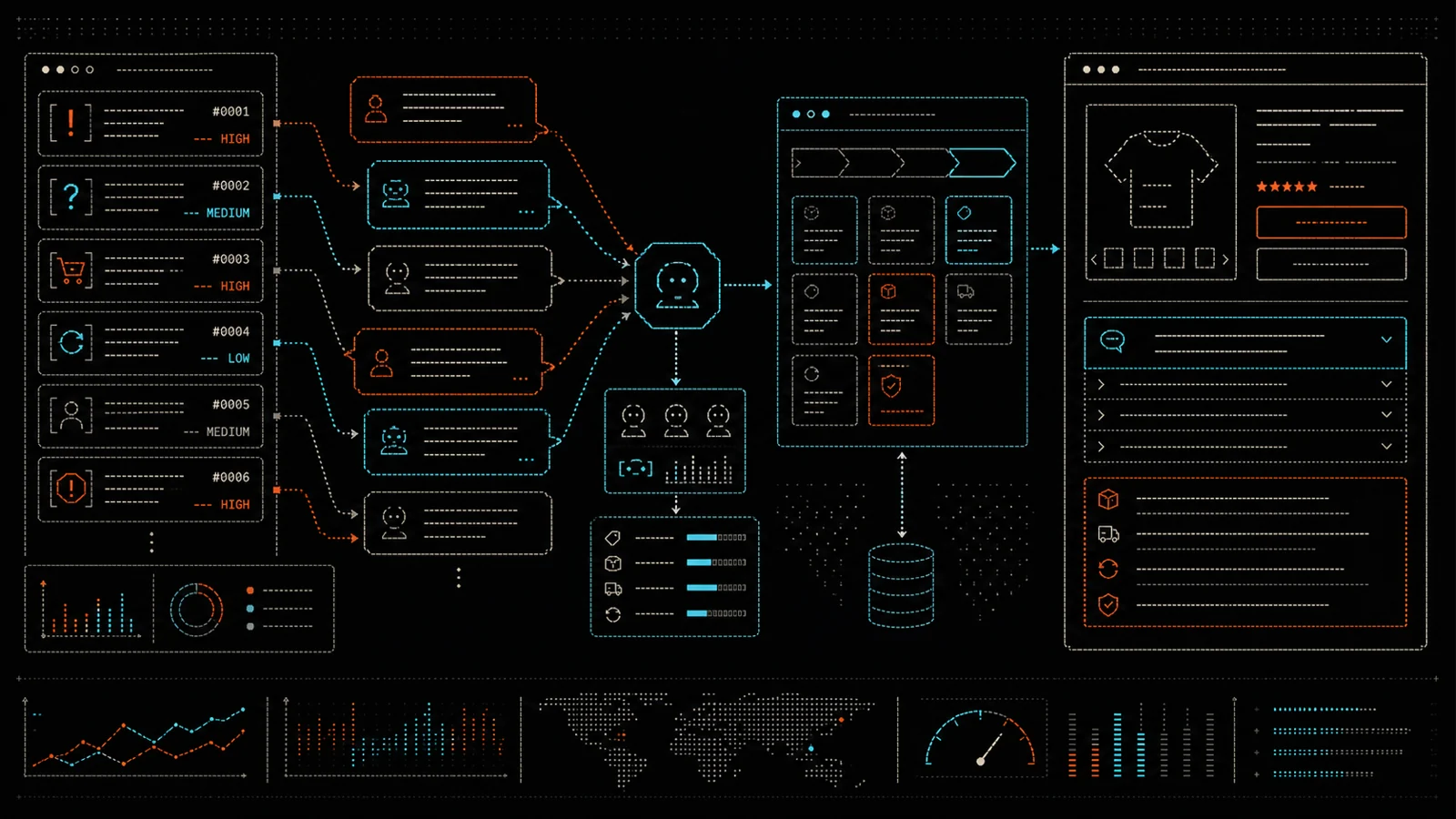
Input: support tickets, live chat transcripts, AI agent handoff logs, return reasons, product metadata, FAQs, and policy pages.
Agent task: cluster repeated questions, map them to SKUs, suggest PDP FAQ updates, draft support macros, and flag products with high confusion.
Human review: approve product accuracy, policy wording, edge cases, legal or safety claims, and escalation rules.
Output: PDP FAQ blocks, better support macros, agent training notes, Shopify Flow automations, and issue ideas for future content.
The best support automation does not hide the messy questions. It shows the team exactly where the store needs clearer context.
What to fix first
Start with the questions that appear before purchase.
Post-purchase support matters, but pre-purchase confusion directly affects conversion. If shoppers ask support whether a product fits, what comes in the box, or whether it works with another item, that belongs on the product page.
Then look for ticket clusters by product.
If one SKU creates repeated questions, it needs a PDP pass. If one category creates repeated questions, it may need a buying guide. If one policy creates repeated questions, it may need clearer language across the store.
Do not ask AI to solve the symptom only.
Fix the source page.
Tool radar: Gorgias
Gorgias is worth watching because its support AI is tied directly to commerce data, especially for Shopify brands. The interesting workflow is not only ticket deflection. It is using support conversations to improve buying context.
Best for: Shopify brands with enough support volume to see repeated pre-purchase and post-purchase patterns.
Watch if: you want support, shopping assistance, policies, and product data to work from the same context.
Not for: teams that have not documented product and policy details clearly enough for an agent to answer safely.
Workflow fit: support question to PDP fix, macro, or agent-training note.
Disclosure: editorial watchlist reference. Affiliate links will be marked if added later.
Team action
Pull the top 10 support questions from the last 30 days.
For each one, write:
- question;
- related SKU or category;
- current answer;
- where the answer should live;
- PDP, FAQ, policy, or email update needed;
- whether an AI agent may answer it;
- when to hand off to a human.
Then update the product page for the most common pre-purchase question.
Output: one lower-friction product page and a cleaner training source for support automation.
Resource CTA
Add a “support question” column to your SKU audit, and use the buyer-question template in the AI Shelf Checklist. If buyers keep asking the same thing, your next AI workflow should probably start by making that answer easier to find.
Source links
- Gorgias AI Agent: https://docs.gorgias.com/en-US/ai-agent-101-497772
- Siena AI: https://www.siena.cx/
- Okendo Surveys: https://support.okendo.io/en/articles/6574578-welcome-to-okendo-surveys
- Shopify Flow Reference: https://help.shopify.com/en/manual/shopify-flow/reference