Reviews are not just social proof anymore.
For years, the basic job was straightforward: collect stars, show a few quotes on the product page, and hope the average rating made the shopper feel safer.
That still matters. But the more interesting shift is upstream.
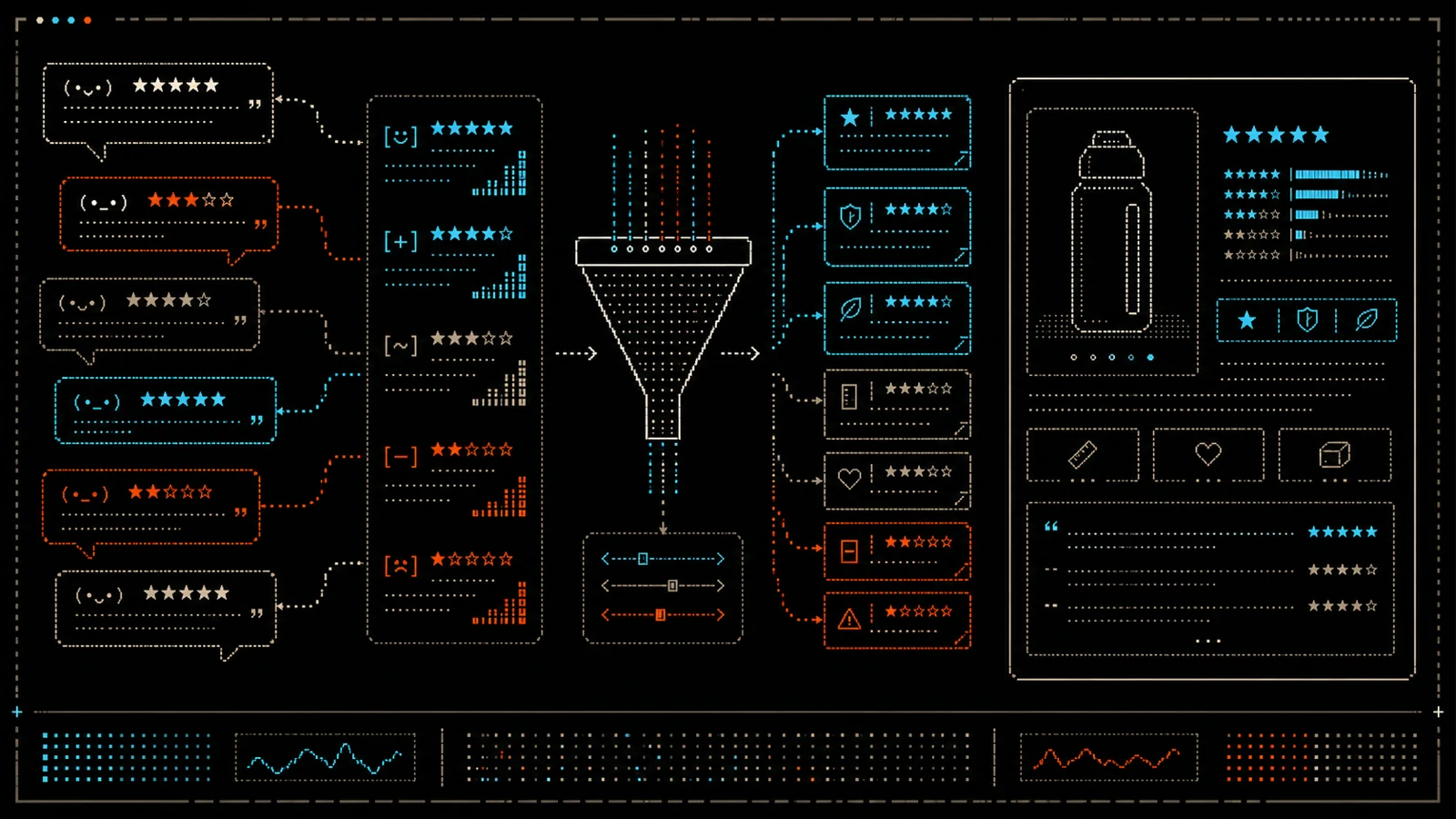
Reviews are becoming workflow inputs. They tell you what customers actually noticed, what confused them, which claims felt credible, which use cases were missed, and where the product page did not prepare the buyer well enough.
If AI is going to help write PDP sections, ad angles, lifecycle email blocks, and support answers, the review layer becomes one of the cleanest sources of buyer language.
In this brief
- Reviews are moving from display widgets to customer intelligence.
- PDPs should be updated from repeated review themes, not just internal copy meetings.
- Tool Radar: Okendo as a customer marketing and review-intelligence layer.
- Team action: run a review-to-PDP audit on one high-value SKU.
The signal
Review platforms are expanding beyond “collect and show ratings.”
Okendo positions its platform around reviews, loyalty, quizzes, surveys, referrals, and customer insight. Yotpo’s reviews product emphasizes review and UGC collection, on-site displays, galleries, and search visibility. Klaviyo is connecting more customer data into marketing profiles, segmentation, AI, and flows.
The pattern is clear: customer feedback is no longer a passive badge.
It is becoming data that can travel into merchandising, retention, creative, and support.
That matters because most stores have a language gap. The product page says one thing. Reviews say another. Support tickets reveal the confusing part. Ads test a third angle. Email flows repeat whatever the team wrote months ago.
The more automated the stack gets, the more expensive that gap becomes.
Why this matters for commerce
AI does not automatically know what your buyers care about.
It can summarize a page. It can draft a headline. It can rewrite a product description. But if the inputs are only the existing product page and a generic brand guide, the output tends to repeat the same stale story.
Reviews bring a different layer:
- buyer vocabulary;
- real objections;
- unexpected use cases;
- sizing, fit, taste, texture, quality, packaging, or setup issues;
- comparison language;
- post-purchase delight;
- recurring disappointment.
That information should not stay trapped inside a review widget.
It should shape the PDP.
Workflow lens
Input: reviews, Q&A, support tickets, returns notes, post-purchase surveys, and product metadata.
Agent task: cluster themes, identify repeated objections, extract proof points, flag missing PDP details, and draft copy or creative angles.
Human review: check claims, tone, legal/compliance risk, product accuracy, and whether the suggested copy over-promises.
Output: updated PDP sections, clearer size or usage guidance, ad angles, lifecycle email blocks, support macros, and product-feed notes.
The goal is not to let an agent rewrite your store unchecked. The goal is to stop ignoring the best buyer language you already have.
What teams usually miss
Most brands look at reviews in aggregate.
Average rating. Number of reviews. Maybe a few featured quotes.
That hides the operational value. A 4.6-star product can still have a repeated problem: confusing assembly, unclear sizing, missing accessories, misleading photos, weak packaging, or an ingredient concern.
Those themes are not just CX issues. They are page-content issues.
If ten buyers say “I wish I knew this ran small,” the PDP needs clearer fit guidance.
If reviews repeatedly mention “bought this for travel,” the product page, email flow, and ad creative should probably test travel language.
If support keeps answering the same pre-purchase question, the PDP probably failed before the shopper asked for help.
Tool radar: Okendo
Okendo is worth watching because it sits close to the customer feedback layer: reviews, surveys, quizzes, referrals, and loyalty.
Best for: Shopify brands that want reviews and customer intelligence to feed merchandising and retention decisions.
Watch if: you want review themes, survey answers, and quiz data to become inputs for PDP updates and lifecycle segmentation.
Not for: teams that only want a lightweight review badge and are not ready to act on customer feedback.
Workflow fit: customer feedback to PDP and retention improvements.
Disclosure: editorial watchlist reference. Affiliate links will be marked if added later.
Team action
Pick one high-value SKU. Pull the last 50 to 200 reviews, plus any support questions tied to that product.
Create five columns:
- repeated praise;
- repeated objections;
- missing information;
- buyer language worth reusing;
- PDP update to test.
Then make one page change.
Do not boil the ocean. Add the fit note, usage detail, comparison line, FAQ block, image caption, or proof point that the feedback is already asking for.
Output: one better product page and a repeatable review-mining workflow.
Resource CTA
Add a review and objection column to your top-SKU audit. The AI Shelf Checklist includes a buyer-question template for exactly this. The easiest AI workflow is often just making the product page smarter with the customer language you already have.
Source links
- Okendo: https://okendo.io/
- Yotpo Reviews: https://www.yotpo.com/platform/reviews
- Klaviyo Features: https://www.klaviyo.com/features