Anthropic just made its most capable public model tier available to more teams.
The headline is Claude Fable 5, a new Mythos-class model that Anthropic says is built for harder coding, knowledge work, vision, and long-running agentic tasks. It launched on June 9, 2026 alongside Claude Mythos 5, a more restricted-access version for approved customers.
For commerce teams, the useful question is not whether this model tops a benchmark.
The useful question is: what kind of work should a team be willing to hand to a model that can stay with a messy task for hours or days?
The answer starts with a better task brief.
In this brief
- Claude Fable 5 is a signal that long-running AI work is moving into normal business workflows.
- Commerce teams should test it on bounded work: catalog cleanup, PDP audits, creative briefs, support analysis, and reporting.
- Tool Radar: Claude Fable 5 as a high-capability model for source-heavy commerce work.
- Team action: write a commerce task brief before giving any model a broad operational assignment.
The signal
Anthropic describes Claude Fable 5 as a Mythos-level model for ambitious, long-running work. The company says it can work across agents, coding, enterprise knowledge tasks, and vision-heavy document analysis.
The technical details matter because they shape workflow fit. Anthropic’s docs list Claude Fable 5 as generally available through the Claude API, Claude Platform on AWS, Amazon Bedrock, Vertex AI, and Microsoft Foundry. The model supports a 1 million token context window and up to 128,000 output tokens, with adaptive thinking always on.
Anthropic also added safeguards. Its Fable page says flagged cybersecurity and biology queries are automatically routed to Claude Opus 4.8, and that Fable requires 30-day data retention for safety monitoring. The API docs add fallback and billing behavior for cases where the request moves to another model.
That combination is the real story: more capable models are arriving with more workflow-level rules attached.
This is not just “choose the smarter model.”
It is “decide which work deserves a smarter, slower, more expensive model, then wrap that work in boundaries.”
Why this matters for commerce
Most commerce AI projects fail because the assignment is vague.
“Improve this store.”
“Find opportunities in our catalog.”
“Write better ads.”
“Analyze our customer feedback.”
Those prompts sound useful, but they skip the operating system around the task: source inputs, success criteria, cost expectations, brand rules, claims review, product truth, channel limits, and who signs off before anything changes.
A more capable model does not remove that need.
It makes the need more important.
If a model can inspect hundreds of PDPs, read reviews, compare support tickets, draft ad angles, summarize analytics, and propose page changes, then the team needs to define where the work starts and stops. Otherwise a high-capability model can produce a polished plan that is still too broad, too expensive, or too disconnected from the store’s real constraints.
For an e-commerce operator, Claude Fable 5 is interesting when the task has enough source material and complexity to justify the model:
- auditing a category page and the top PDPs against reviews, returns, and support themes;
- turning messy product data into a creative testing brief;
- finding repeated pre-purchase questions and drafting PDP FAQ updates;
- reviewing a campaign landing page against brand rules, product truth, and offer terms;
- summarizing a month of store metrics into actions for merchandising, lifecycle, and creative.
That is different from asking it to write a subject line.
Use the expensive model where judgment, context, and long-horizon follow-through matter.
Workflow lens
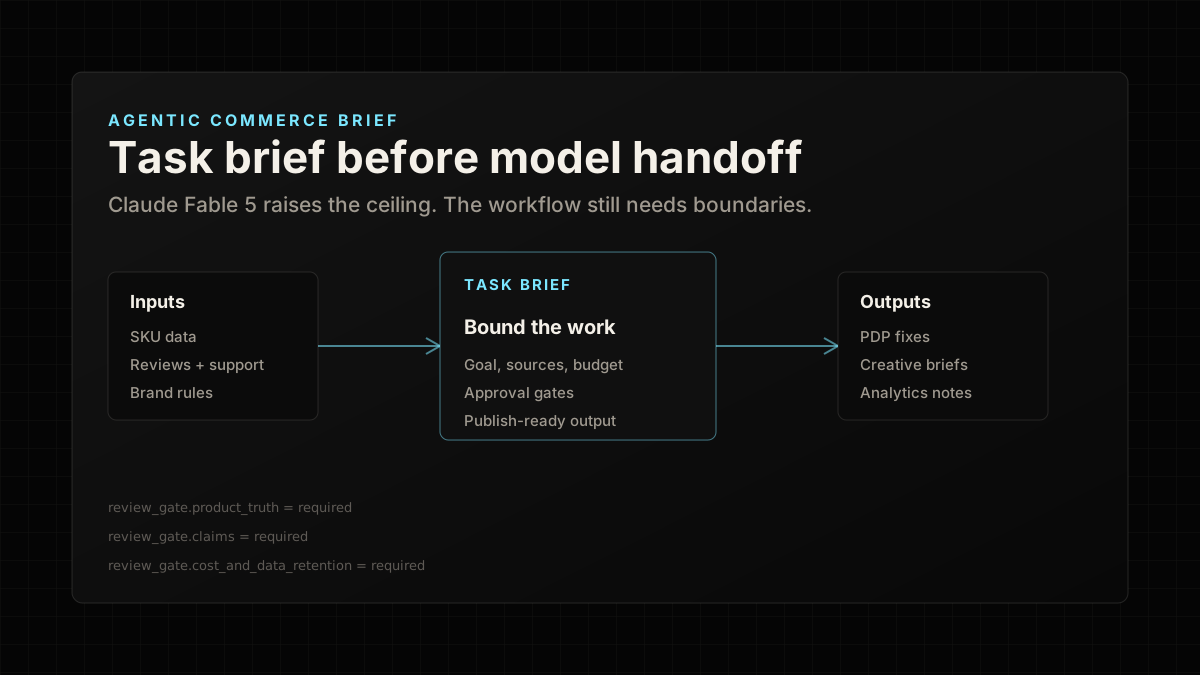
Input: product feed data, PDP copy, reviews, support tickets, return reasons, analytics exports, brand rules, offer terms, and channel specs.
Agent task: inspect the source material, find repeated patterns, propose changes, draft structured outputs, and check its work against the goal.
Human review: approve product accuracy, claims, tone, pricing or offer language, compliance risk, data retention fit, and whether the output is worth publishing.
Output: PDP update briefs, creative testing briefs, support-to-FAQ recommendations, analytics summaries, landing page review notes, and approved next actions.
The workflow is not “let the model run the business.” The workflow is “give the model a scoped assignment that would otherwise take a sharp operator half a day, then review the result like you would review work from a teammate.”
The task brief is the control surface
Before using a frontier model for commerce work, write the brief in plain language.
Include:
- Objective: what decision or artifact should come out of the work?
- Source list: which files, URLs, exports, docs, and screenshots may the model use?
- Out of scope: what should it avoid changing, guessing, or recommending?
- Constraints: budget, time, channel rules, brand rules, and risk areas.
- Review gates: who checks product truth, claims, data handling, and final copy?
- Output format: table, brief, ticket list, PDP patch, email block, or report.
- Stop condition: when should the model pause and ask for direction?
This is the difference between delegation and drift.
A good task brief also makes model comparison easier. Run the same brief through your current workflow and a more capable model, then compare the output. Did it find better issues? Did it reduce review time? Did it stay inside the boundaries? Did the cost make sense?
Tool radar: Claude Fable 5
Claude Fable 5 is worth watching because Anthropic is positioning it around long-running agentic work, complex coding, enterprise knowledge work, and vision. Those are the same capabilities commerce teams need when the work spans products, customer feedback, screenshots, policies, and analytics.
Best for: source-heavy assignments where the model needs to hold a lot of context, inspect multiple materials, and return a structured artifact for review.
Watch if: your team already has clean enough inputs to run PDP audits, catalog reviews, creative brief generation, support analysis, or analytics summaries.
Not for: routine short copy tasks, low-stakes rewrites, or workflows where 30-day model-provider data retention is not acceptable.
Workflow fit: commerce source bundle to reviewed task brief, findings, and next actions.
Disclosure: editorial watchlist reference. No affiliate relationship.
Team action
Pick one workflow where your team already has source material but still loses time to manual synthesis.
Use this four-step test:
- Step 1: Choose one bounded task, such as “audit the top 10 PDPs in this category against reviews and support tickets.”
- Step 2: Write the task brief with source list, output format, constraints, and review gates.
- Step 3: Run the brief through your normal model or current process, then through Claude Fable 5 if your team has access.
- Step 4: Compare findings, review time, cost, data retention fit, and whether the output can become a ticket or publishable draft.
Output: one reusable task brief and a clearer rule for when a frontier model is worth the extra capability.
Quick hits
- Anthropic says Claude Fable 5 is generally available, while Claude Mythos 5 is limited to approved Project Glasswing customers and other trusted access programs.
- The Claude docs list
claude-fable-5as the API model ID, with a 1 million token context window and up to 128,000 output tokens. - AWS says Bedrock access requires opting into provider data sharing for Fable 5 because Anthropic requires 30-day retention for Mythos-class traffic.
- Simon Willison’s initial hands-on testing points to the same practical category: meaty, multi-step software and agent tasks where the model can keep working through a complex brief.
Resource CTA
Turn one messy commerce workflow into a source bundle. Add the task objective, source links, review owner, and approval notes before testing any frontier model on it.
Source links
- Anthropic launch announcement: https://www.anthropic.com/news/claude-fable-5-mythos-5
- Claude Fable 5 product page: https://www.anthropic.com/claude/fable
- Claude API docs: https://platform.claude.com/docs/en/about-claude/models/introducing-claude-fable-5-and-claude-mythos-5
- Claude models overview: https://platform.claude.com/docs/en/about-claude/models/overview
- AWS News Blog: https://aws.amazon.com/blogs/aws/anthropic-claude-fable-5-on-aws-mythos-class-capabilities-with-built-in-safeguards-now-available/
- Simon Willison initial impressions: https://simonwillison.net/2026/Jun/9/claude-fable-5/