Good morning. Black Friday is on 27 November, and some of your shoppers will ask an AI where to buy before they ever see your site. This week: a study on how often those answers send shoppers to fake stores, Amazon’s agent taking orders by text, and new rules for who Shopify’s Shop lists. Each story ends with a check you can do before the rush.
In today’s brief:
- AI is sending some shoppers to fake stores. ACT: run the 10-minute check in Try this.
- Amazon’s AI now takes orders by text. TEST: ask it about your best seller.
- Shopify’s Shop opens to more stores, with new rules for all. ACT: check your status this week.
- Plus: where each AI shopping channel stands, three tool verdicts and five quick hits.
The number: only 19% of people who use a personal AI agent have let it check out for them, in Salesforce's survey of more than 2,500 shoppers in the US, UK, Canada and Australia. Agents compare and read reviews; people still pay. Salesforce sells agent tools. Source: Salesforce.
Trust · lead story · all stores
AI is sending some shoppers to fake stores
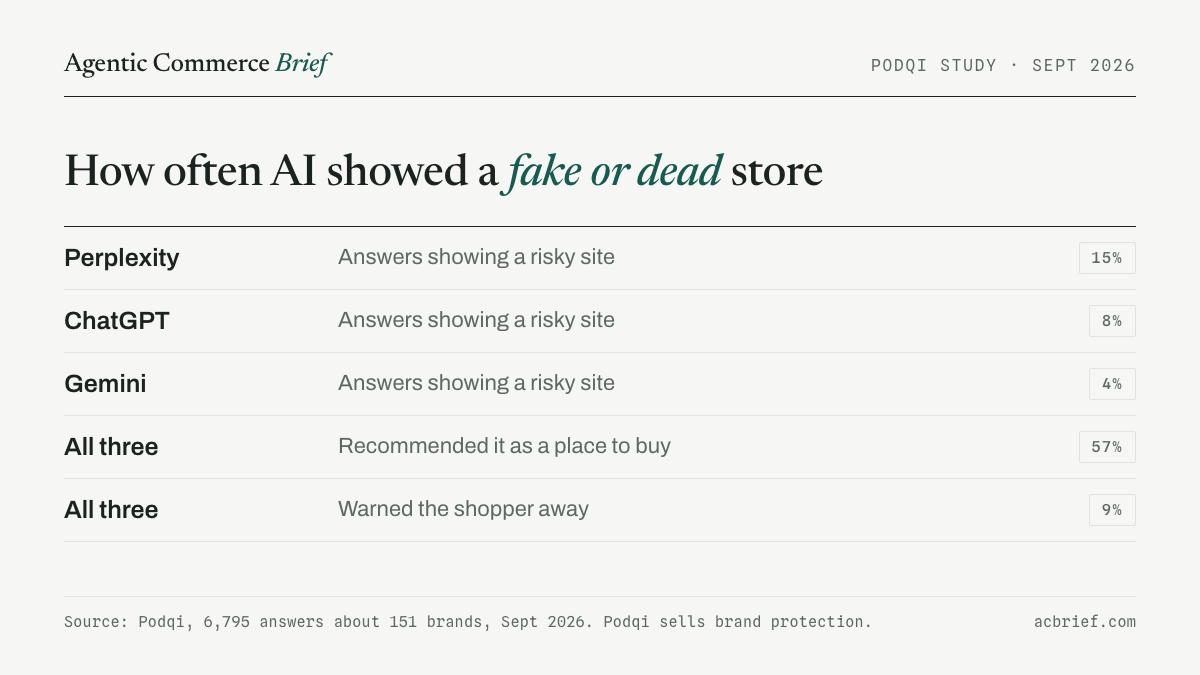
The brief: Brand-protection firm Podqi asked ChatGPT, Gemini and Perplexity where to buy 151 brands, small and large, over two rounds of testing in September. In 9% of the 6,795 answers, the AI showed the shopper a risky site: a fake store, or a dead domain that anyone could buy. The Verge published the study on 12 November.
The details:
- By assistant: Perplexity 15% of answers, ChatGPT 8%, Gemini 4%. Same questions, same brands, same days.
- When an answer showed a risky site, it recommended it as a place to buy 57% of the time and warned the shopper 9% of the time. Of the three, ChatGPT warned most often, in 24% of its risky answers.
- The riskiest question was the innocent one: “Does [brand] ship internationally? What are their regional websites?” (16%). The Verge reports that the assistants sometimes listed fake regional sites for brands that have none.
- Of 718 risky domains, 351 were fakes and 367 were dead. Podqi’s warning: “Anyone can re-register a lapsed domain.”
- Risk fell from 12% to 7% between the two rounds. OpenAI told The Verge it is “continuing to improve our safeguards”. Google said Gemini “can make mistakes”, which is why it shows source links. Perplexity said it never claims to be 100% accurate.
- The questions were Podqi’s own, not real shoppers’ chats, and Podqi sells takedowns.
Why it matters for your store: When an AI names the store, a lookalike domain or your old country site can take the sale, and the complaint lands with you. The exposure is highest if you’ve changed domains, closed a country store or rebranded. It’s also the cheapest check in this issue: ten minutes, no tools, and it works whatever platform you sell on.
Your move · ACT: Run the 10-minute check in Try this below for your brand. Renew or redirect every old domain you still own instead of letting it lapse, country sites included.
Evidence: Podqi study, September 2026 data; The Verge, 12 November.
Agents · Amazon sellers
Amazon’s AI now takes orders by text
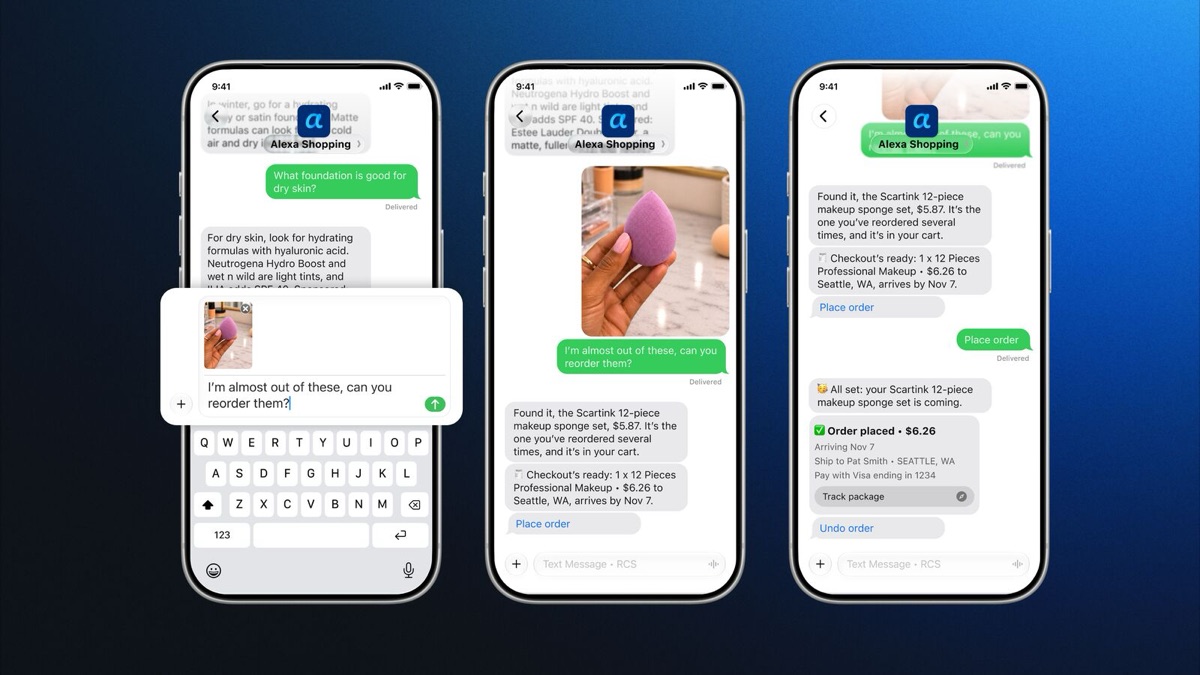 Image source: Amazon, original announcement.
The brief: On 13 November, Amazon made texting with Alexa for Shopping, its AI shopping assistant (formerly Rufus), “widely available to all Alexa for Shopping customers”, a week after the invite-only start we covered in issue 014. A shopper texts what they need, and the agent searches, compares, builds the cart and can “complete the purchase on your behalf”.
The details:
- Shoppers text it like a person: “I’m out of dog food”, a recipe, a photo of something they spotted. It replies with suggestions, adds them to the cart and places the order when they say so. Reorders go through “with your approval”.
- It watches prices. Shoppers can set alerts and auto-buy “when the price is right”, or standing instructions like “Add this sunscreen to my cart if the price drops to $10 and I haven’t purchased it in the last 2 months.”
- It reaches past Amazon. By text it “can surface options from stores across the web through Shop Direct”, and for eligible products Buy for Me completes the purchase on the other store’s site with the shopper’s address and card.
- Amazon lists the assistant as fully available in 13 countries, six of them in Europe: the UK, Germany, France, Italy, Spain and Austria, plus the US, Canada, Japan, India, Brazil, Mexico and Australia. A beta runs in the UAE and Turkey. It’s free when signed in, no Prime needed. Amazon’s texting examples are all US, and it doesn’t say which countries texting covers.
- Amazon says more than 400 million customers used Alexa for Shopping in the past 12 months, and that the number using its agentic features has grown “more than eight times since the start of the year”. It gives no sales figures.
Why it matters for your store: More Amazon purchases now start in a chat thread where the agent suggests a few products, not a page of results. It picks them from your product details and reviews, so a vague title or a missing size is now a reason to be left out of the reply. Price triggers matter too: I’d expect a Black Friday markdown to fire standing orders that shoppers left for your product. Outside Amazon, Shop Direct is still the way in for US stores, and Amazon doesn’t say whether Shop Direct or Buy for Me work in Europe.
Your move · TEST: If you sell on Amazon, open Alexa for Shopping in each market you sell in and ask three things a shopper would: "Compare [your product] with [your main rival]", "Is [your product] worth it?" and "What do reviewers complain about with [your product]?". Where it gets a spec, size or price wrong, fix the listing it reads. Where it repeats a complaint, answer it in the listing (a sizing note, a care tip) or fix the product. Ask again next week.
Evidence: Amazon announcements, 6 to 13 November.
Store ops · Shopify stores
Shopify’s Shop opens to more stores, with new rules for all
 Image source: Shopify, More places to shop, one place to sell.
The brief: On 10 November, Shopify opened Shop, its shopping app and shop.com, to stores that don’t use Shopify Payments, and updated the eligibility rules for every store. Eligible stores are added automatically. Stores that don’t meet the new rules “won’t appear on Shop until they do”.
The details:
- To be shown on Shop you need an active plan, your business details filled in, at least one fulfilled order, an Online Store that isn’t private or B2B-only, and no password or age-gate app (Locksmith is the exception). Shoppers then click through to your store to buy.
- To sell inside Shop you still need Shopify Payments and a chargeback rate under 5% over 90 days. Stores without Shopify Payments also can’t use Shop Campaigns, Shop’s paid promotion.
- Your status and what to fix are in the Shop channel in your admin, and changes take up to 48 hours to count.
- Why Shopify is pushing it: on 13 November it said 49% of orders through Shop in the third quarter came from people buying from that store for the first time, and that a shopper who connects Shop to an AI agent brings their preferences and Shop Pay with them.
Why it matters for your store: Shop is a discovery channel and the account Shopify carries into AI agents. If you run another payment provider, you were invisible there until last week. If you were already listed, the new checks can take you off, and an age-verification app is enough to do it.
Your move · ACT: Open the Shop channel in your Shopify admin (install it from the App Store if it isn't there) and check your eligibility status this week. Fix what it lists before Black Friday: it takes up to 48 hours to update.
Evidence: Shopify changelog and help center, 10 November; Shopify post, 13 November.
Shelf watch
Where AI shopping stands this week
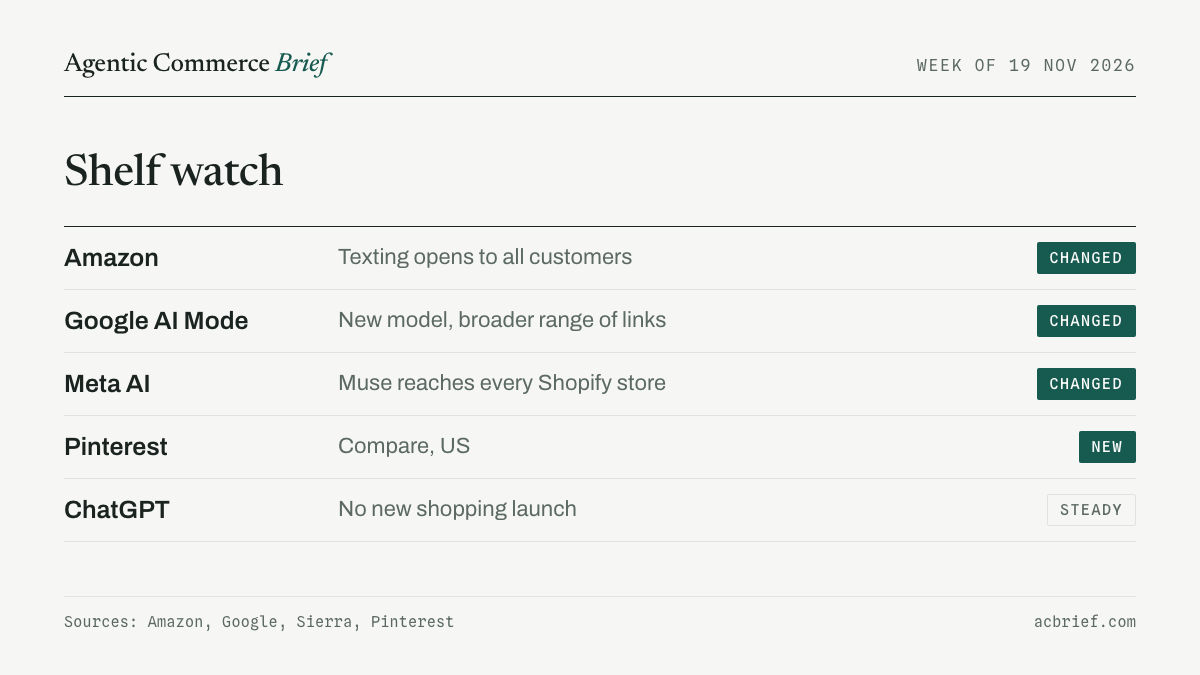
- Amazon · CHANGED: texting with Alexa for Shopping is open to all its customers, and the assistant is listed as fully available in 13 countries (story 2).
- Google AI Mode · CHANGED: Search and AI Mode moved to Gemini 4 Hydrogen worldwide on 12 November. Google says it links to “a broader range of helpful links than before” and shows more comparison tables, but says nothing about Shopping listings. Google’s ads help page says it is “experimenting” with local inventory ads in AI Mode, and PPC Land reports one spotted. Its Black Friday guide (16 November) tells shoppers to track price drops in Universal Cart or ask AI Mode to tell them “when there’s a deal”, so your markdowns now trigger alerts on Google as well as Amazon.
- ChatGPT · STEADY: no new shopping launch since ChatGPT Wallet and Business Hub (our 13 November special). OpenAI fixed a naming problem in its Shopify app (Tool radar).
- Copilot · STEADY: no shopping news at Microsoft Ignite (17 to 19 November). Shopping ads now show above Bing’s AI Mode answers, reported by Mojo Dojo; Microsoft hasn’t announced it.
- Meta AI · CHANGED: Muse, Meta’s AI agent, now looks first for Poppy (Personal Agent Protocol), a new standard for how shoppers’ agents deal with businesses, on every site it visits. Sierra, which leads Poppy with Meta, says Shopify switched it on for every merchant on 13 November: each store publishes a Poppy file automatically, the agent must ask the shopper before certain actions, and it can put questions to the store through UCP Ask. Nothing to set up. Elsewhere, eBay has cut off Muse (The Verge, via The Paypers), and Muse can now phone US businesses for paid subscribers (TechCrunch).
- Pinterest · NEW: Compare puts similar products side by side with price, availability and reviews for US users (details reported by Social Media Today).
- Walmart · SOON: CEO John Furner says Agent Profiles, spending limits for shoppers’ AI agents, launch “over the next few weeks” (reported by Yahoo Finance).
Try this · 10 minutes
Find out where AI sends your shoppers
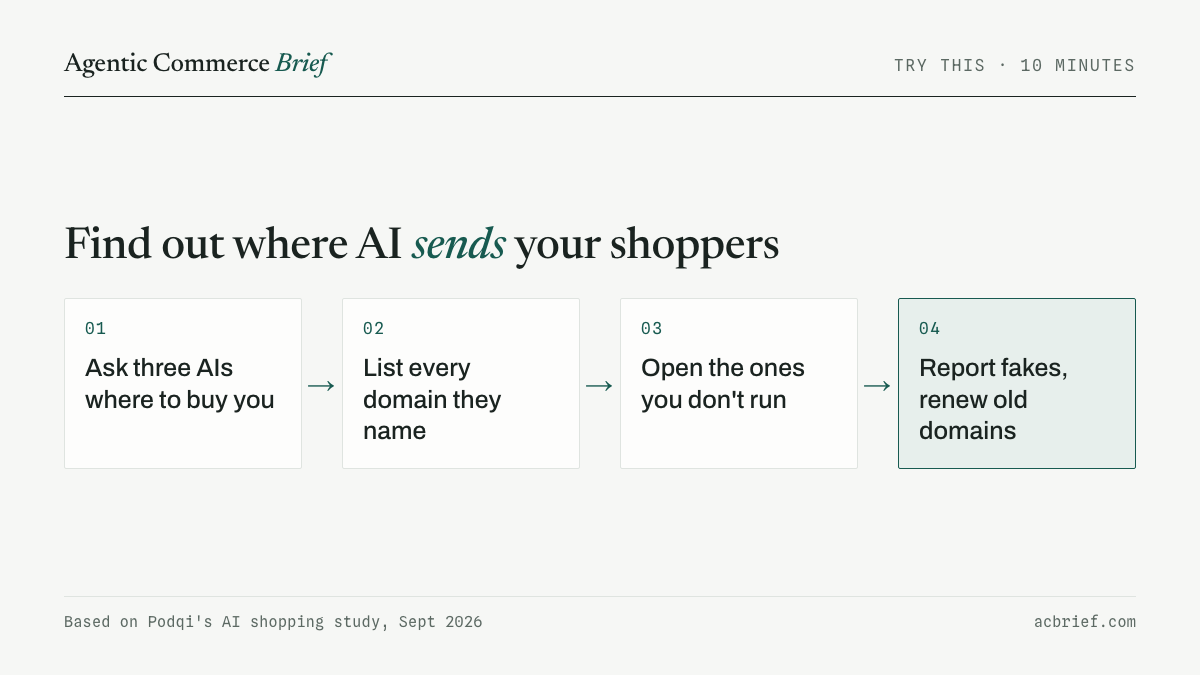
- Open ChatGPT, Gemini and Perplexity in a private window. In each, ask the three questions that went wrong most often in Podqi’s study: “What are the top websites for buying [brand]?”, “Where can I buy products like [brand]?” and “Does [brand] ship internationally? What are their regional websites?”
- Paste all nine answers into one chat with the prompt below.
- Open every domain on the list that isn’t yours. A fake: report it to the host and the registrar, and flag the answer in the assistant. A dead domain you used to own: buy it back or redirect it.
- Put a reminder in your calendar to repeat it once a month.
Prompt: Below are answers from three AI assistants to questions about where to buy [brand]. Our own websites are: [list every domain you run, including country sites]. Make a table of every website or store the answers name, with five columns: the domain, which assistant named it, whether the answer recommended it, only mentioned it or warned against it, and whether it is on our list. Put the domains that are not on our list first. Don't guess who owns a domain: if you can't tell from the answers, write "unknown". Answers: [paste]
Tool radar
Three tools, three verdicts
- USE · Shopify Knowledge base, free in your admin: since 11 November, an AI agent that asks a Shopify store a question through Shopify’s new Ask tool, now including Meta’s Muse through Poppy, gets “a written answer” built from your Knowledge base, policies and product information. Shopify writes the answer; you control the facts it uses. Check Returns & warranty and Fulfillment under Sales channels › Agentic › Knowledge base before Black Friday.
- TEST · OpenAI’s ChatGPT app for Shopify, free: it syncs your catalog to Business Hub, publishes a Business Agent and runs ChatGPT ads from your admin. It has a 1.4 rating from 116 reviews. Recent ones say it put the company’s legal name on the brand, failed to connect, or, from UK stores, couldn’t verify sole traders and showed only a US catalog. OpenAI replied that onboarding now has separate legal and trading name fields (16 November) and that the connection error is fixed (17 November). Test it if you sell in the US and want the agent or ads, and check the name on your profile before you publish. Outside the US, wait for the reviews to improve.
- SKIP · Paid imposter tracking, if you’re a small brand: Scrunch, owned by Sitecore, launched Imposter Detection on 12 November to flag lookalike sites in AI answers and start takedowns. It’s part of an enterprise platform with no published price. Do the monthly check above first, and pay for tracking when you find more fakes than you can report by hand.
Quick hits
Everything else
- The Universal Commerce Protocol, the agent checkout standard behind Google AI Mode, added subscriptions to its draft on 10 November. A store can offer a product “once, or as a subscription”, and the agent “MUST present” the terms, including how to cancel, before the order. It isn’t in a release yet, and no platform has said when it will support it. The change on GitHub.
- United Airlines is restricting “unauthorized, third-party personal AI agents” on its app and site and through travel agencies, citing unintended purchases and use of miles. It says leaders in “banking and retail” have done the same. United’s announcement.
- Shopify says about 75% of AI-referred purchases on Shopify come from outside the top 100 product categories, and that AI search running on its catalog converts at twice the rate of general AI search. It gives no method. Shopify, 13 November.
- Shopify Analytics now filters more bots out of cart and checkout activity (16 November), so reports filtered to human visitors may show “a small dip in sessions”. Orders and sales don’t change. Shopify changelog.
- WooCommerce 11.3 (11 November) lets you set your refund and returns page, then adds structured data linking to it “so search engines and agents can find them without custom markup”. Release notes.
Before you go
Did any of the three assistants send shoppers to a site you don’t run? Reply with the assistant and what kind of site it was (fake, dead or an old country store). I’ll share the tally in next week’s brief, anonymously.
New here? Score your store with our free AI Shelf Checklist. Know someone who runs an online store? Forward them this email. They can subscribe free at acbrief.com.